


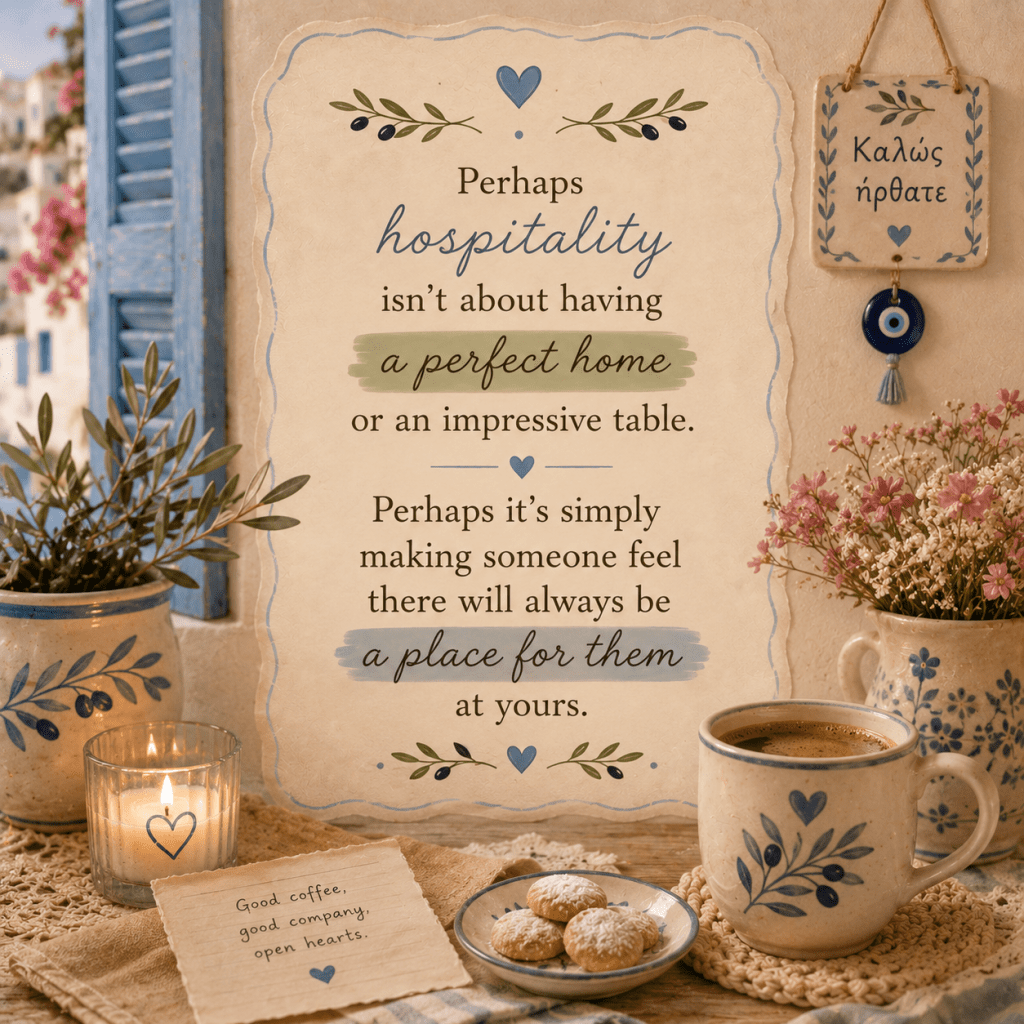
Filoxenia: The Greek art of making sure nobody leaves hungry.
There is a dangerous sentence to say when visiting a Greek home: ”No thank you, I am not hungry”.
You may genuinely believe this but your host does not. You might have eaten twenty minutes ago. Irrelevant. You might insist you are only staying for five minutes. Adorable, but no. Because, somewhere between walking through the front door and sitting down, a plate of something will appear in front of you. Probably, several plates.
Welcome to filoxenia.
The Greek word φιλοξενία – filoxenia is usually translated as hospitality. But, somehow, that translation has always felt a little too small.
The word itself comes from philos – friend or love and xenos – stranger or guest.
At its heart, it’s the idea of showing friendship and generosity towards someone who enters your space. And it has very deep roots in Greek culture.
In ancient Greece, hospitality towards strangers was considered a sacred responsibility, closely associated with Zeus Xenios, the protector of guests and strangers. Thousand years later, the gods may no longer be turning up at the front door in disguise, but the instinct remains.
Someone enters your home? You offer them something. Immediately.
First: Coffee.
”Would you like a coffee?”
This question will arrive before you’ve sat down. And coffee, of course, rarely travels aloe.
”Would you like something with it?”… You say no. A small plate of biscuits appears anyway. This is merely Phase One. Perhaps some cake, or koulourakia, or something homemade. And if you try, you demonstrate willingness. The operation expands.
Then comes the Food.
At some point, somebody asks ”Have you eaten?”. This is another question that isn’t really a question. There is only one correct answer. And strangely, even a ”yes” may result in food.
And something is coming out of the kitchen. Perhaps a pie, perhaps the leftovers from lunch. Maybe tomatoes and feta appear, some bread, olives, fruit… And you watch the table slowly fill while repeatedly saying: ‘‘Honestly, I am fine”.
Nobody is listening. You have been adopted for the afternoon, so you might as well accept your fate.
And when you think it’s over….
Fruit. There is always another stage. You’ve had coffee and biscuits, something savoury, something sweet. Surely, this is finished. But no. Someone has remembered there is karpouzi – watermelon in the fridge. And obviously, you cannot leave without watermelon. It’s summer, there are rules
But, that’s the part I love.
We can joke about the quantities of food and believe me, we should. But beneath it, there is something I find beautiful. Because the food isn’t really the point, or the coffee. What your host is actually saying is: You are welcome here. Sit down. Stay a little longer. Let me take care of you. Let me give you something. You don’t have to earn your place at the table, there’s a chair waiting for you.
And perhaps, that’s why filoxenia feels like more than hospitality. Hospitality can sound formal. Perfect tablecloths, matching plates, a prepared dinner and everything arranged before the guests arrive.
Filoxenia doesn’t require any of that. Sometimes, it’s simply opening the fridge and saying: ”Let’s see what we have”. It’s cutting a slice of bread, putting another plate on the table, making that coffee and moving everyone slightly closer together because there’s always room for more.
Discover more from
Subscribe to get the latest posts sent to your email.


